
Have you ever wondered why you can’t just power your entire house with a single, super-advanced solar panel the size of a laptop?
The answer isn’t about human engineering; it’s about the physics of the sun itself. To understand how solar power works, we have to start at the very beginning: the absolute maximum amount of energy the sun delivers to the surface of the Earth.
The Golden Rule: 1 kW/m²
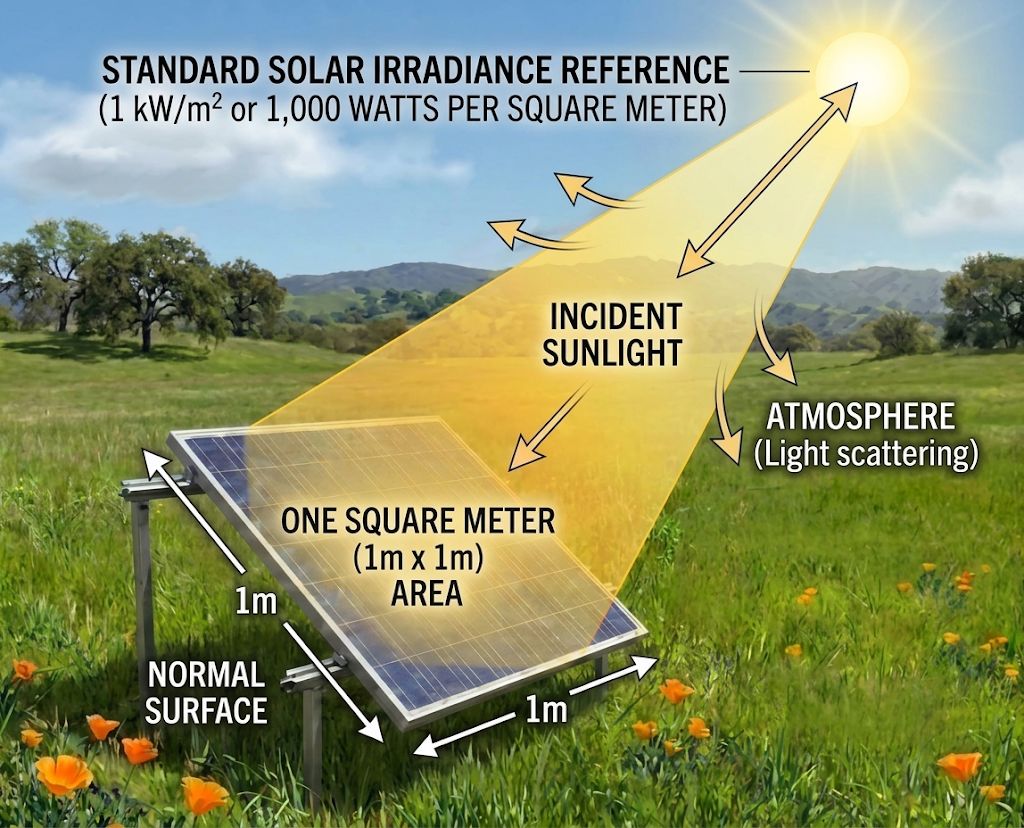
As our diagram above illustrates, there is a fixed limit to raw solar power. On a perfectly clear day, when the sun is shining straight down, it delivers exactly 1,000 watts (or 1 kilowatt) of energy to every square meter of ground.
This 1,000 W/m² figure is the universal baseline, known as Standard Solar Irradiance.
Think of it like a rainstorm. If it’s raining at a steady rate of one inch per hour, the only way to catch more water is to put out a wider bucket. You can’t force more rain to fall into a small cup. Solar energy works exactly the same way. The “rain” of sunlight falls at a maximum rate of 1,000 watts per square meter, so catching more power requires physically larger panels.
Angle is Everything
Look closely at the panel in the graphic. Notice the label marking the “Normal Surface.”
To catch that full 1,000 watts, the panel must be perfectly perpendicular—or “normal”—to the incoming sunlight. If you tilt the panel away from the sun, the same amount of light energy is spread over a larger physical area, diluting the power. This is why professional solar installers spend so much time calculating the perfect pitch for your roof. If your panels aren’t facing the sun head-on, you are leaving energy on the table.
The Atmospheric Filter
You might be wondering: is the sun only producing 1,000 watts? Not at all. At the outer edge of space, sunlight is significantly stronger.
But as the graphic shows, before that incident sunlight hits your panels, it must pass through miles of the Earth’s atmosphere. Moisture, dust, and air molecules act like a giant, invisible filter, scattering and absorbing a portion of the light before it ever reaches the ground. The 1,000 watts we measure is simply what survives the trip down to the surface.
What This Means for Your Roof
This basic physics lesson explains why solar arrays take up so much space. If you know the physical size of a solar panel and its efficiency rating, you can easily calculate its maximum potential output because you know the starting number will never exceed 1,000 watts per square meter.