
INVESTMENT PROPOSAL & LEGAL MEMORANDUM
TO: Investment Committee & Program Officers
FROM: Project Leadership Team
DATE: September 27, 2026
SUBJECT: Program-Related Investment (PRI) for Renewable Energy Open-Source Competitive Benchmarking Initiative
PRIMARY CHARITABLE PURPOSE: Renewable Energy Research, Education, and Public Advocacy (IRC § 501(c)(3) & § 4944(c))
1. Executive Summary
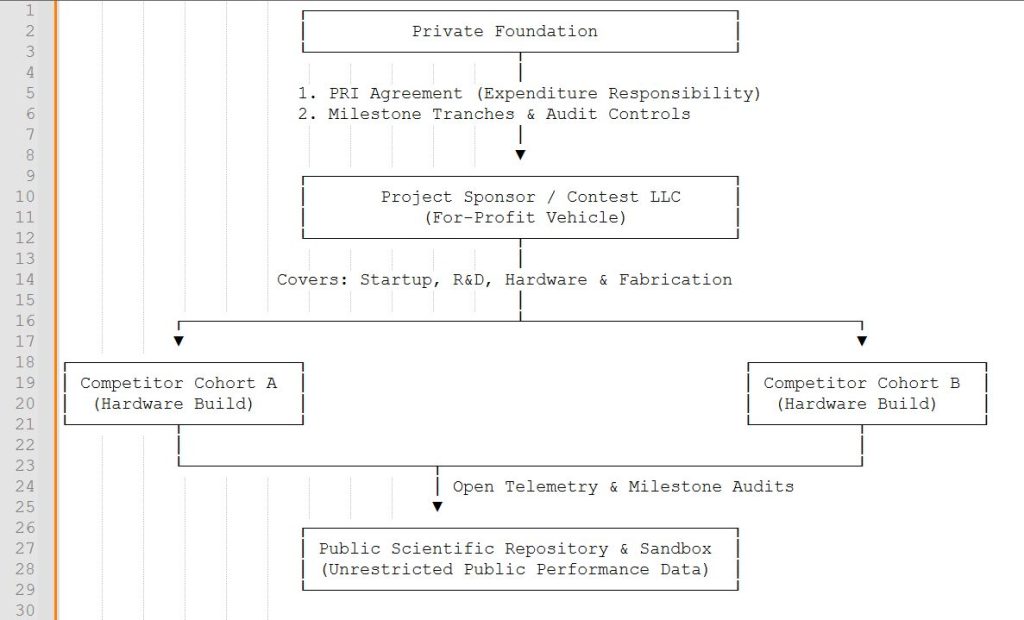
This proposal outlines a structured Program-Related Investment (PRI) framework under Internal Revenue Code (IRC) § 4944(c) to deploy catalytic capital into an innovative for-profit limited liability company (LLC).
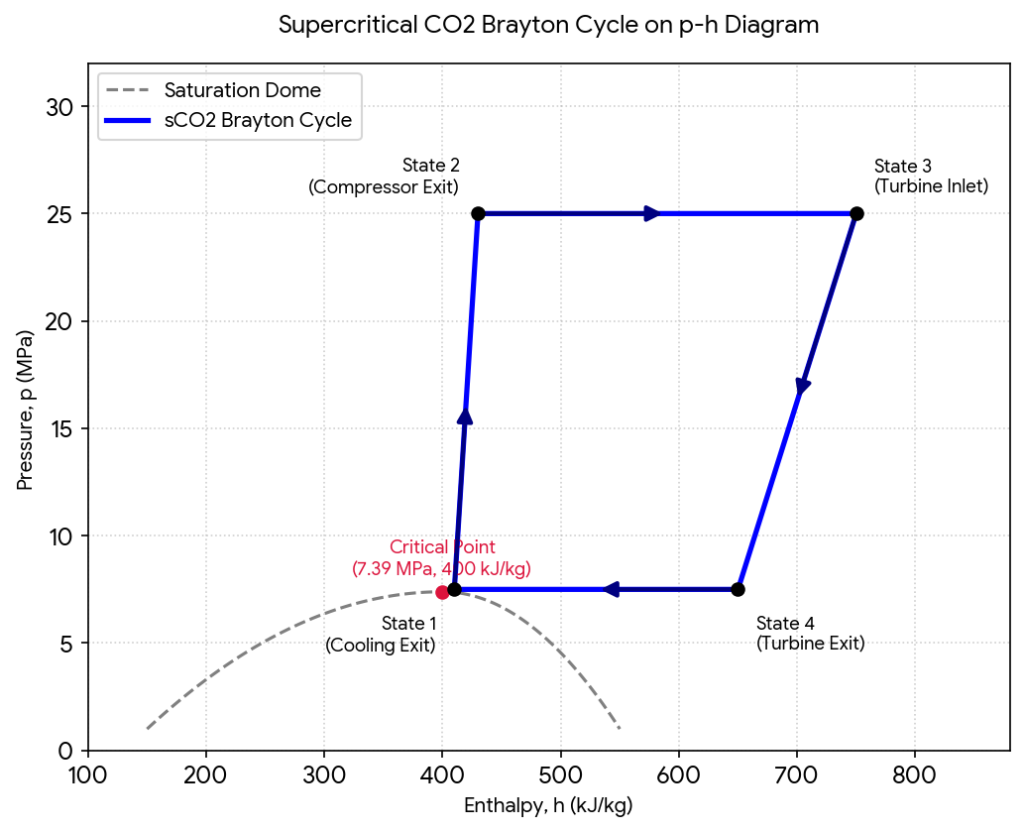
The initiative organizes an open-source technical competition to accelerate next-generation clean energy technology—specifically focusing on high-efficiency, solar-powered supercritical carbon dioxide ($\text{sCO}_2$) turbine generation systems. Through performance-contingent milestone funding, the project finances the design, engineering, construction, commissioning, and testing of competing prototypes, while publishing unvarnished operational telemetry and build records directly to the scientific community and the general public.
2. Legal Pathway: Structuring a PRI for a For-Profit LLC
Under Treasury Regulation § 53.4944-3, a private foundation can make an investment (equity, loan, or recoverable grant) into a for-profit entity if it satisfies a strict three-prong statutory test:
- Primary Charitable Purpose: The primary purpose of the investment is to accomplish one or more charitable, scientific, or educational purposes described in IRC § 170(c)(2)(B).
- No Significant Investment Purpose: No significant purpose of the investment is the production of income or the appreciation of property (conventional commercial investors would consider the risk-return profile unattractive due to the open-source dissemination mandates).
- No Disallowed Political Campaign or Lobbying Activities: No purpose of the investment is to engage in legislative lobbying (under IRC § 4945(d)(1)) or participate in political campaigns (under IRC § 4945(d)(2)).
Why the LLC Structure Serves the Scientific Mission
Commercializing hardware breakthroughs requires engineering talent, rapid vendor procurement, and manufacturing infrastructure often constrained within traditional non-profit entities. The for-profit LLC acts as an agile execution chassis while contractually binding its operational goals to educational and scientific transparency through an enforceable PRI Agreement.
3. Mutual Strategic Benefits
Benefits to the For-Profit LLC
- Non-Dilutive / Patient Risk Capital: Provides seed and growth capital capable of taking deep-tech hardware risk that venture capital or traditional commercial lenders systematically avoid.
- Full-Stack Operational Coverage: Finances upfront capital expenditure (CapEx), testing equipment, engineering talent, and test-bench site acquisition without early liquidation or product-market-fit pressure.
- Open-Source Pre-Commercial Validation: Builds credibility across the global thermodynamic and power-engineering ecosystems by establishing verified, peer-reviewed hardware metrics.
- Long-Term Commercial Spinoff Potential: While core benchmark data remains open-source, participating engineers and firms retain the baseline competencies needed to iterate secondary technologies.
Benefits to the Foundation
- Fulfills the 5% Annual Minimum Distribution Requirement (MDR): Under IRC § 4942, funds deployed via PRIs count dollar-for-dollar toward the foundation’s annual distributable amount as qualifying distributions.
- Capital Recycling: Loan repayments or shared-savings distributions return capital back to the foundation’s balance sheet, replenishing endowment assets for future charitable rounds.
- Decisive Market-Maker Impact: Eliminates scientific black-box gatekeeping by obligating all contestants to publish real-world conversion efficiencies, operational temperatures, and cycle-stability curves.
- Defensible Tax Position: Fulfills scientific discovery and education exemptions through systematic public access to data.
4. Full Project Lifecycle Funding (The Contest Program)
The PRI directly finances the entire contest lifecycle, insulating contestants from upfront financial hurdles:

- Startup & Operational Mobilization: Legal structuring, site safety accreditation, grid interconnection permits, and test-pad facilities.
- Engineering Human Capital: Salaries for mechanical engineers, control software developers, CFD (computational fluid dynamics) modelers, and instrumentation technicians.
- Hardware Procurement & Prototyping: Custom turbomachinery machining, microchannel heat exchangers, high-temperature solar collectors, sealed sCO₂ loops, and precision flow meters.
- Commissioning, Rig Setup & Maintenance: Facility electrical loads, dynamic load banks, safety containment blast shields, ongoing fluid replacement, and recalibration procedures.
5. Scope of Expenditure: Allowable vs. Prohibited
Because the recipient is a for-profit entity, the foundation must adhere to strict Expenditure Responsibility rules under IRC § 4945(h).
Allowable Use of Funds by the Recipient
- Direct Engineering & Personnel Expenses: W-2 wages and 1099 contractor fees for systems engineers, mechanics, and open-source data pipeline architects.
- Capital Assets & Instrumentation: Real-time NIST-traceable sensor suites, pressure transducers, thermocouples, solar concentrator fields, and variable-frequency electronic dynamometers.
- Test Site Buildout & Facility Costs: Rent, power drops, security, and environmental controls for the dedicated benchmarking facility.
- Education & Dissemination Infrastructure: Maintenance of public web servers, open APIs, data validation repositories, and technical publication production.
Allowable Administrative Costs for the Foundation
- Independent Third-Party Engineering Verification: Retaining independent professional engineers (PE) to inspect rigs, authenticate calibration logs, and audit contest rules.
- PRI Legal Drafting & Tax Structuring: Outside counsel fees for drafting the custom PRI note/loan agreement, charter covenants, and expenditure responsibility filings.
- Monitoring & Milestone Audits: Foundation staff travel and direct overhead related to on-site testing verification and financial ledger reconciliations.
Strictly Prohibited Expenditures
- Lobbying & Political Activity: Any attempt to influence state or federal legislation, municipal zoning incentives, or ballot initiatives (IRC § 4945(d)(1)).
- Proprietary Enclosure / Trade Secret Hoarding: Concealing efficiency curves, failure modes, material specs, or operational metrics under proprietary NDA barriers.
- Private Benefit / Inurement: Excessive executive compensation, diversion of funds to insider affiliates, or non-arms-length vendor contracts (IRC § 4945(d)(5)).
- Non-Programmatic Commercial Inventory: Mass manufacturing runs or sales inventory unrelated to test-bench evaluation.
6. End-to-End Foundation Workflow
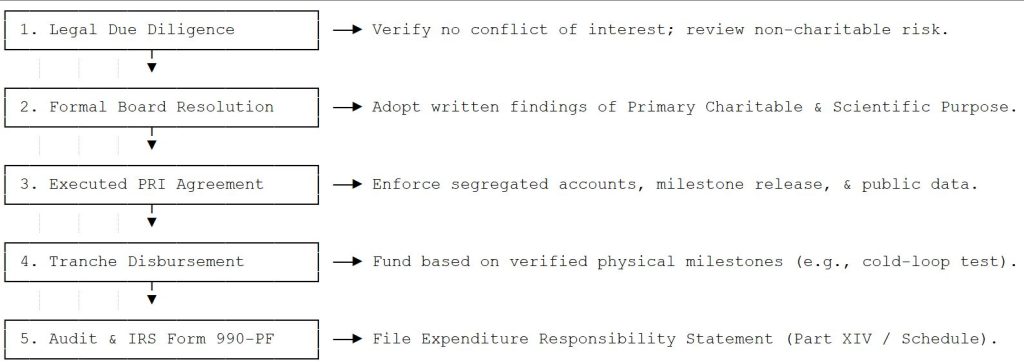
To ensure full compliance and safeguard the foundation’s tax-exempt status, the deployment follows an operational workflow:
Operational Checkpoints
- Charitable Purpose Formulation: The board articulates that funding the sCO₂ turbine contest accelerates thermodynamics research that the private capital markets underfund due to early-stage technology risks and open data requirements.
- PRI Agreement Execution: Contractually defines:
- Mandatory segregated bank accounts for foundation funds.
- Explicit requirement for quarterly financial statements and milestone reports.
- Obligation to publish raw sensor telemetry under an open-access license.
- Full clawback mechanisms if funds are diverted or data is suppressed.
- Milestone-Gated Releases:
- Tranche 1: Entity standing, test rig siting, sensor calibration protocols.
- Tranche 2: Successful fluid circulation and subsystem pressure containment.
- Tranche 3: Full operational runs under concentrated solar loads, accompanied by immediate public data broadcasts.
- Form 990-PF Reporting: The foundation maintains detailed compliance records on its annual IRS Form 990-PF (Part IX-B and Part XIV), documenting the recipient’s name, tranche amounts, project progress, and verified charitable outputs.
7. The Program Architecture: The Open sCO₂ Turbine Challenge
The Technical Challenge
Supercritical carbon dioxide ($\text{sCO}_2$) systems operate at exceptional fluid densities and thermal efficiencies compared to traditional steam Rankine cycles, holding enormous promise for high-temperature Concentrated Solar Power (CSP). However, aerodynamic losses, micro-clearance sealing issues, and extreme pressure dynamics regularly stall commercial development.
The Competition Mandate
- Universal Boundary Conditions: Each contestant is provided identical high-temperature thermal inputs and cooling parameters.
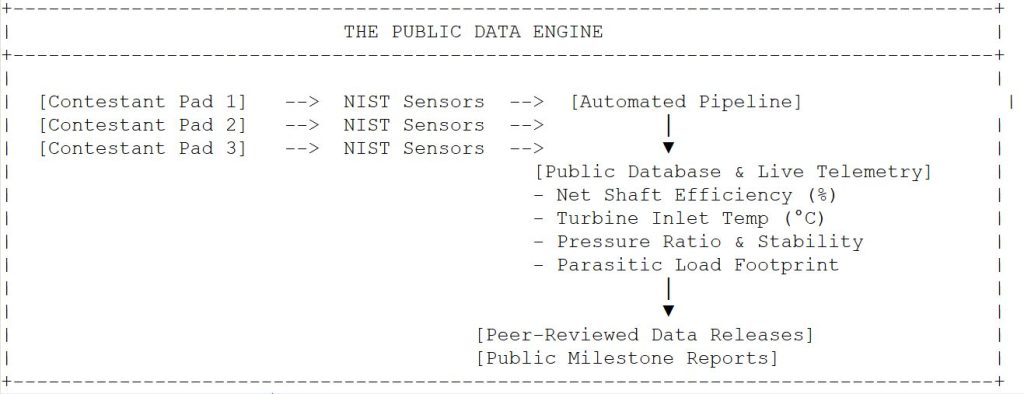
- Transparent Instrumentation: Foundations provide unified, tamper-proof edge meters recording inlet temperatures, mass flow rates, electrical production, and parasitic pumping power.
- Radical Transparency:
- Build Milestones: Published fabrication costs, bill of materials, and failure diagnostics.
- Operational Dashboards: Raw, second-by-second telemetric data streams accessible to academic researchers, clean energy startups, and regulatory bodies worldwide.
8. Conclusion and Call to Action
By funding this initiative through a Program-Related Investment, the Foundation bridges the pre-commercial hardware “valley of death” while enforcing public open data access. This structure minimizes technical risk, protects foundation tax status, fuels rapid engineering iterations, and delivers transparent, publicly accessible performance data to advance clean energy generation globally.